
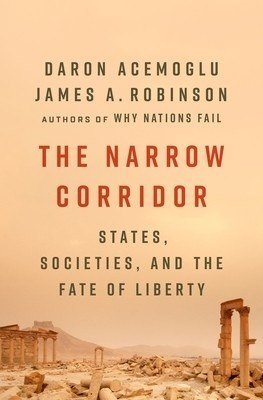
Liberty Is Fragile and Has to Be Defended
I recently finished reading The Narrow Corridor: States, Societies, and the Fate of Liberty by Daron Acemoglu and James A. Robinson. It follows their earlier book, Why Nations Fail, and takes up a more specific question: under what conditions do societies manage to be free?
Their answer is that liberty depends on a balance between a capable state and a mobilized society, and that this balance occupies only a narrow space, which they call the corridor.
Here are the lessons that stayed with me.
1. Two Forces in Tension
The authors describe a constant contest between state and society. A strong state is needed to enforce laws, resolve disputes, and provide public services. A strong society is needed to monitor the state and keep it accountable. Liberty depends on both being powerful at once.
2. Three Kinds of Leviathan
The authors name three outcomes. The Despotic Leviathan is a strong state that dominates a weak society. The Absent Leviathan is a society without a capable state, where norms and violence fill the gap. The Shackled Leviathan, found inside the corridor, is a strong state constrained by an active society.
3. The Red Queen Effect
Inside the corridor, state and society both grow stronger as they compete, a dynamic the authors compare to the Red Queen in Alice in Wonderland, who must run to stay in place. Liberty, in this account, is not a settled state of affairs. It is a continuing effort.
4. History Matters, but Not Absolutely
The authors use examples from many parts of the world, including ancient Athens, medieval Europe, and modern states, to show how different paths led to different outcomes. They take care to say that history shapes the possibilities without fixing them.
5. Paper Leviathan
They also describe a state that looks capable on paper but has little real authority, with laws that nobody enforces. Such a state offers the appearance of order without its substance.
Why This Matters Beyond Political Theory
The framework is useful for thinking about states that have faced long periods of conflict or weak institutions, and about the difference between order imposed from above and order that grows with the participation of citizens.
It is also a reminder that no country has completed this work. Even long-established democracies can slip out of the corridor if citizens stop paying attention.
Final Reflection
The book is broad, and some readers will find its categories too neat for the complexity of real history. But its central message is persuasive and sobering.
Freedom is not a gift that arrives once. It is something societies have to keep earning.
Keep Reading
The Personal MBA: Key Lessons and Reflections
Josh Kaufman’s The Personal MBA argues that the core ideas of business can be learned without a classroom or a degree. In this reflection, I share the lessons that stayed with me and why they matter beyond business school.
Thinking, Fast and Slow: Key Lessons and Reflections
We like to believe our decisions are rational. Daniel Kahneman’s Thinking, Fast and Slow shows how often we are guided by shortcuts instead. In this reflection, I share the ideas that stayed with me and why they matter far beyond psychology.
Atomic Habits: Key Lessons and Reflections
Big change rarely arrives as one dramatic moment. In Atomic Habits, James Clear argues that it is built from tiny daily decisions that compound over time. In this reflection, I share the ideas that stayed with me and why they matter far beyond personal productivity.
Comments
No comments yet — be the first to share your thoughts.